To show up in Google AI Overviews, your page must be indexed, snippet-eligible, and good enough to be picked as a supporting link when Google’s AI assembles an answer. Google is explicit that there are no special requirements or magic markup: the same fundamentals that earn rankings earn AI Overview citations. What changes is the competition – the AI cites only a handful of sources per answer, so clarity, authority, and answer-first structure decide who gets in.
This guide breaks down how AI Overviews and AI Mode actually choose sources, what Google officially says you need (and do not need), a practical playbook, and how to measure your visibility. It is the Google-specific companion to our broader answer engine optimization pillar.
How AI Overviews pick their sources
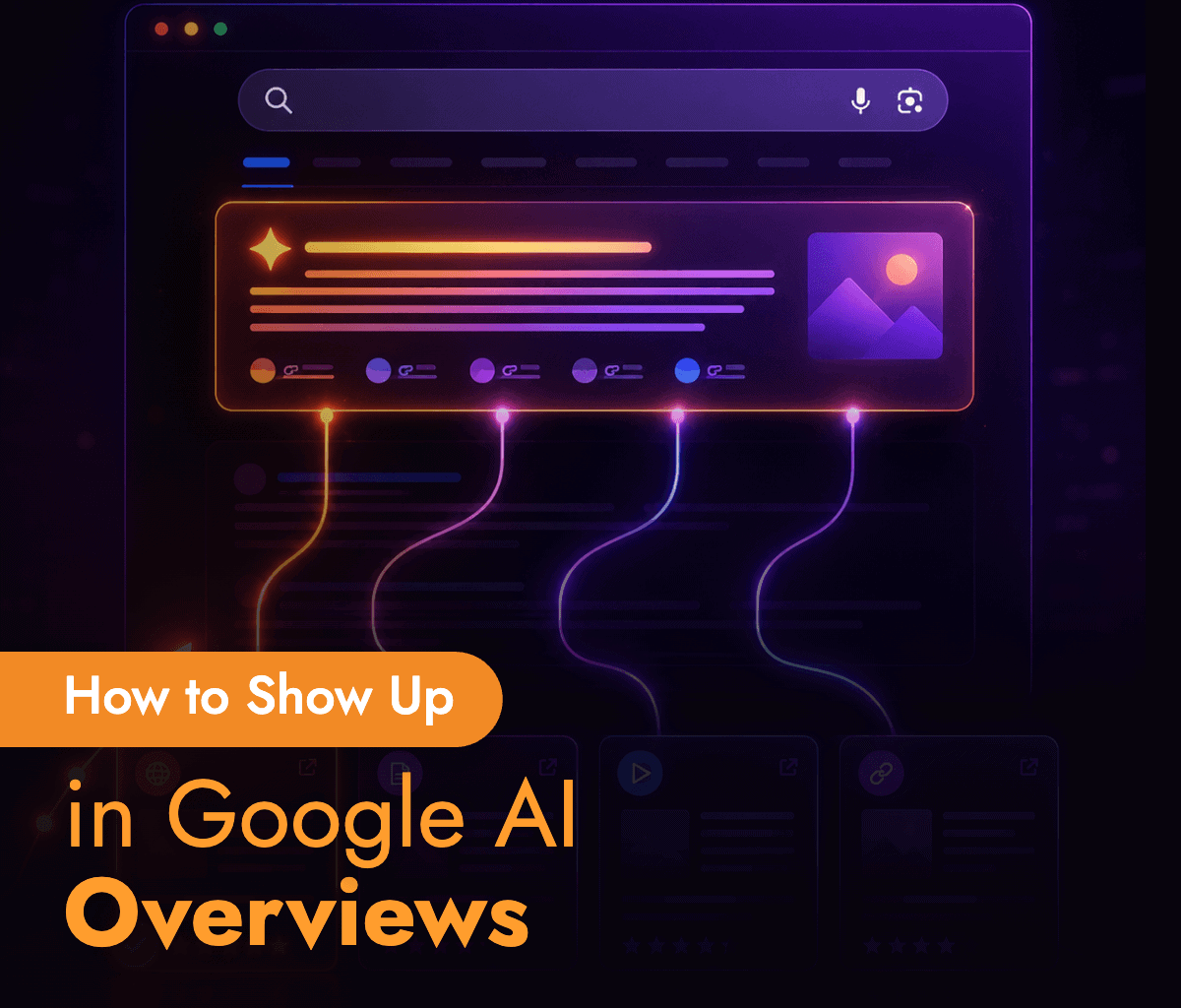
AI Overviews appear when Google’s systems decide an AI summary adds value beyond the classic results. To build one, Google uses a “query fan-out” technique: it silently runs multiple related searches across subtopics, gathers candidate pages, and has its models pick supporting links for the generated answer. That has a practical upside Google itself highlights – the fan-out surfaces a wider, more diverse set of pages than a classic results list, which is an opening for sites that never won position one.
There are no additional requirements to appear in AI Overviews or AI Mode, nor other special optimizations necessary.
AuthorGoogle Search Central, AI features and your website
Take that quote seriously in both directions. There is no secret AI file or schema that unlocks inclusion, so ignore anyone selling one. But “no special requirements” does not mean “no competition” – eligibility is just the entry ticket. The pages that get cited are the ones a model can read, trust, and quote in one pass. Google also reports that clicks arriving from pages with AI Overviews tend to be higher quality, with users spending more time on the sites they visit.
Sources and further reading
This guide draws on primary documentation and current industry data:
Google Search Central – AI features and your website (official guidance, including the query fan-out explanation).
Google Search Central – Search Essentials and technical requirements.
Google Search Central – Creating helpful, reliable, people-first content.
Google Search Console documentation – how AI Overviews are counted in the Performance report.
r/TechSEO and r/seogrowth – practitioner discussion on getting into AI Overviews.
Industry AI-visibility studies on which pages AI Overviews cite.
What Google requires vs what actually wins
It helps to separate the official eligibility bar from the competitive reality. The table below puts them side by side.
Layer
What it means
Your job
Eligibility (official)
Page is indexed, snippet-eligible, meets Search technical requirements and policies.
Allow crawling, no noindex/nosnippet, verify in Search Console.
Retrieval
Query fan-out pulls candidate pages across related subtopics.
Cover the topic in depth so your pages match many fan-out queries.
Selection
Models pick a few clear, credible pages to cite as supporting links.
Answer-first structure, accurate facts, strong E-E-A-T signals.
Click quality
AI Overview visitors are fewer but more engaged.
Make the page convert: clear next step, fast load, relevant CTA.
One more official point worth repeating: Google says you do not need new machine-readable files or special schema for AI features. Structured data still helps machines parse your pages – see our guide on schema markup for AI – but it must match the visible text, not replace it.
The AI Overviews optimization playbook
Here is the order of operations we run for clients. Each step compounds the previous one.
Clear the eligibility bar first. Confirm the page is indexed, crawlable in robots.txt (including your CDN), and free of nosnippet or max-snippet limits that would keep it out of AI features. Verify in Search Console.
Answer the question in the first two sentences. AI Overviews lift concise, self-contained answers. Lead each target page with the direct answer, then expand with mechanics and examples.
Structure for the fan-out. Because Google searches subtopics, cover the related questions on the same page with descriptive H2/H3 headings, lists, and tables. Our AEO checklist maps the exact on-page elements.
Keep winning classic rankings. Pages that rank in the top 10 are far more likely to be retrieved as candidates. Keyword targeting, internal links, and backlinks still carry the weight.
Build topical depth. A cluster of connected pages on one subject matches more fan-out queries than a single post, and reads as authority. Interlink the cluster deliberately.
Show E-E-A-T on the page. Named authors, credentials, dates, first-hand specifics, and accurate sourcing. The model cites pages it can trust; so do the quality raters behind it.
Extend the same work to every AI engine. The structure that wins AI Overviews also wins ChatGPT, Perplexity, and Gemini citations – our GEO playbook covers the cross-engine strategy.
How to measure your AI Overviews visibility
Search Console now reports AI Overviews and AI Mode impressions inside the Performance report (Web search type), and Google has begun rolling out dedicated generative AI performance reporting. Watch impressions on your target pages, track referral engagement in GA4, and monitor how often your brand is cited across a fixed set of queries. Our guide on how to measure AI visibility walks through the full metric stack.
The end goal is pipeline, not impressions. In our AI visibility case study, a wellness clinic in a niche where roughly 83% of its tracked keywords trigger AI Overviews went from barely registering to being cited across Google’s AI surfaces, with the same work feeding a steady, measured flow of leads.
Common mistakes that keep you out
Blocking AI crawling or leaving stray nosnippet tags quietly disqualifies pages. Burying the answer under long intros gives the model nothing to lift. Thin one-off posts rarely survive the fan-out against topical clusters. And chasing invented tricks – special AI files like llms.txt, secret markup – wastes time Google has explicitly said changes nothing.
Get cited in Google’s AI answers
Showing up in AI Overviews is earned with the fundamentals, applied precisely and measured honestly. If you want a team to do that for you, see our AI Visibility and GEO services, or request a free AEO and GEO audit to see exactly where your site stands. Running a large, multi-team site? Our enterprise digital marketing services handle AI visibility at that scale. Questions first? Get in touch.
Frequently asked questions
How do you show up in Google AI Overviews?
Make sure the page is indexed and snippet-eligible, then earn selection: answer the query directly in the first sentences, structure the page with clear headings and lists, build topical depth, and keep ranking in classic search. Google confirms there are no additional requirements beyond standard SEO.
Do you need special schema to appear in AI Overviews?
No. Google states you do not need new machine-readable files, AI text files, or special schema for AI features. Structured data still helps engines parse your content, but it must match the visible text and it is not an entry requirement.
Why is my site not showing in AI Overviews?
Common causes: the page is not indexed or is blocked by robots.txt or a CDN, nosnippet or max-snippet limits restrict it, the answer is buried instead of stated up front, or stronger topical authorities win the citation. AI Overviews also simply do not trigger on many queries.
What is query fan-out in AI Overviews?
Query fan-out is Google's technique of issuing multiple related searches across subtopics and data sources to build an AI response. It lets the AI surface a wider, more diverse set of supporting links, which gives well-structured pages a chance to be cited even without ranking first.
How do I track AI Overviews traffic in Search Console?
AI Overviews impressions and clicks are included in the Performance report under the Web search type, and Google has been rolling out dedicated generative AI performance reporting that breaks out impressions in AI Overviews and AI Mode by page, country, and device.
Do AI Overviews reduce clicks to websites?
Clicks on queries with AI Overviews are generally fewer but higher quality. Google reports that users who click through from pages with AI Overviews tend to spend more time on the sites they visit, so the traffic that arrives is more engaged and closer to a decision.
We build the answer-first content, topical depth, and technical foundation that get brands cited in AI Overviews and AI Mode, then track it to leads. Request your free AEO and GEO audit.





 Previous article


