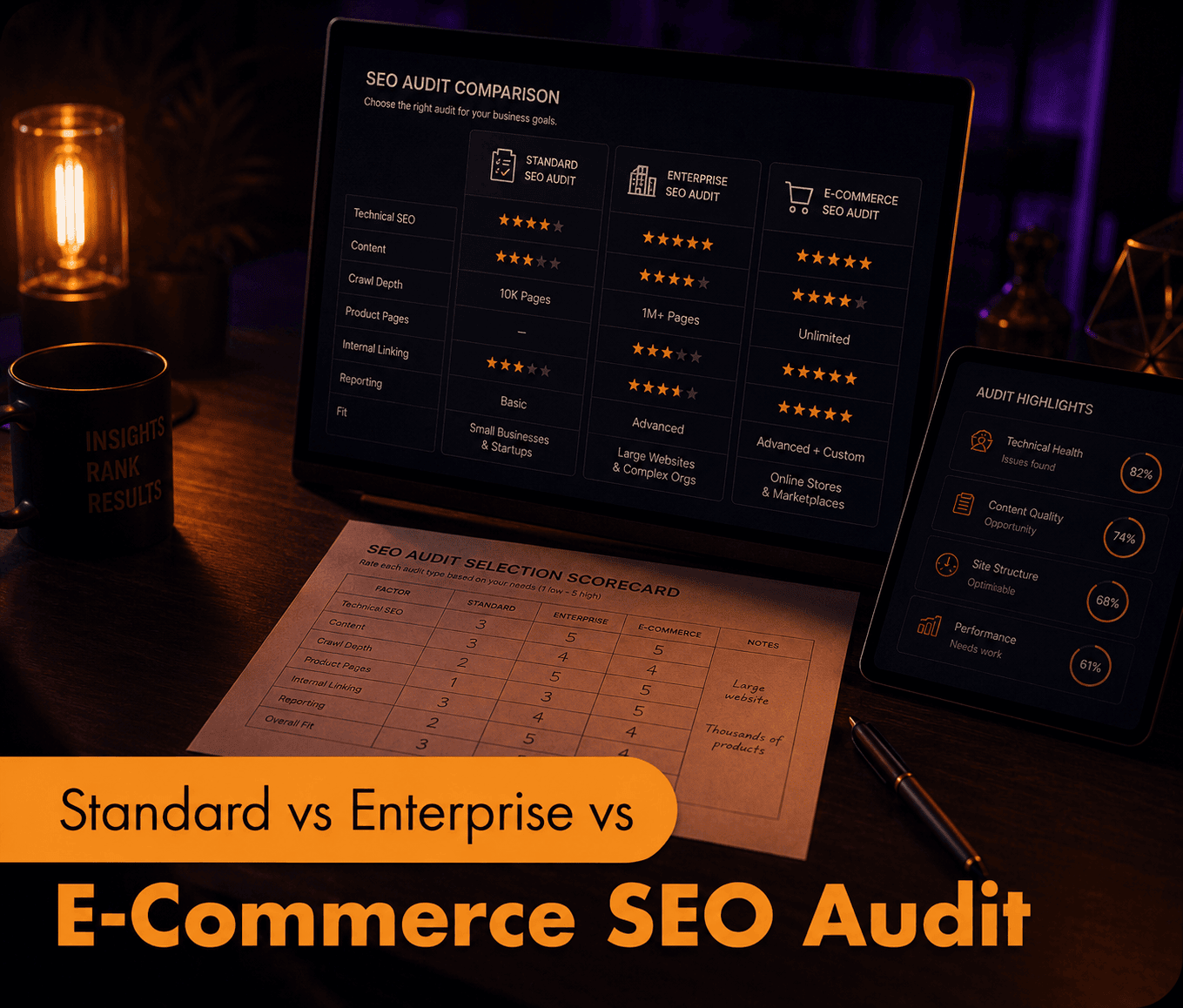
The three audits we run differ across five dimensions: site size, methodology, deliverable depth, timeline, and price. Here is the breakdown.
Standard SEO Audit
Built for: SMB and mid-market sites, a few hundred to a few thousand URLs. Local businesses, B2B service providers, content sites, SaaS marketing sites, regional brands.
Methodology: Third-party crawl tools (Screaming Frog, Sitebulb), manual review of top pages, GSC and GA4 analysis, competitor benchmarking, content audit at sample level.
Deliverable: 30-50 page report, prioritized issue list, 90-day implementation roadmap, strategy walkthrough call.
Timeline: 2-3 weeks.
Covers: Technical SEO, on-page and content, local SEO, AEO and GEO, backlink profile, competitor gap, analytics and tracking.
When it is right: Your site has under 5,000 indexable URLs, single primary market, SEO managed by one person or small team. Most companies start here.
Learn more about our standard SEO audit.
Enterprise SEO Audit
Built for: Sites with 10,000+ indexable URLs, multi-region operations, complex architecture, SEO ownership split across teams (product, content, dev, marketing).
Methodology: Distributed crawls (Screaming Frog enterprise edition, Botify, Lumar), server log analysis, template-level data segmentation, manual review of top templates, regional SERP analysis, stakeholder-aligned reporting.
Deliverable: Tiered reporting – 1-page executive summary, 40+ page deep report, dev-ready ticket spec, 30/60/90-day implementation roadmap aligned with release cycles, separate walkthroughs for leadership and execution teams.
Timeline: 4-10 weeks depending on site size and data access.
Covers: Everything in standard, plus crawl budget at scale, log file analysis, international and multi-region SEO, JavaScript rendering parity, content governance, stakeholder alignment.
When it is right: Your SEO platform shows green but organic revenue is flat. You operate in 3+ countries. Your CMS has multiple business units. Your dev team ships SEO-affecting code without SEO review. Your last audit missed the issues that matter at your scale.
Full methodology on our enterprise SEO audit page. If you need a team to execute the fixes and run growth after the audit, that is what our enterprise digital marketing services cover.
E-Commerce SEO Audit
Built for: Online stores on Shopify, WooCommerce, Magento, BigCommerce, headless commerce setups (Shopify Hydrogen, Next.js Commerce, Magento PWA Studio).
Methodology: Crawl by template (product, category, brand, collection), product schema validation across SKUs, faceted navigation analysis, variant URL handling check, AI shopping visibility audit, conversion-focused SEO review.
Deliverable: Report ranked by impact on traffic and conversion (not just severity), platform-specific recommendations, prioritized fix list for dev, schema and structured data implementation guide.
Timeline: 2-3 weeks for stores under 10,000 SKUs, longer for larger catalogs.
Covers: Everything in standard, plus product page SEO at scale, category and collection architecture, faceted navigation crawl budget, variant URL handling, AI shopping visibility, conversion-focused SEO.
When it is right: You run an online store and your product pages are not ranking despite good products and reviews. Your category pages cannibalize each other. Your schema broke after a theme update. Your products do not appear in AI-driven shopping queries.
“E-commerce SEO has its own playbook – product schema, faceted nav, and category architecture matter more than blog content.” – Search Engine Journal
Details on our e-commerce SEO audit page.
Not Sure Which Audit Fits Your Site?
Pick the wrong scope and you waste money in either direction. Tell us your domain and we will recommend honestly – standard, enterprise, or e-commerce – within one business day.
Get a Recommendation
Quick Decision Framework
Three questions to pick correctly:
1. Do you sell products online?
Yes -> E-commerce audit (regardless of catalog size)
No -> Continue to question 2
2. Does your site have 10,000+ URLs OR operate in 3+ countries OR have SEO split across multiple teams?
Yes -> Enterprise audit
No -> Continue to question 3
3. Do you have a marketing site, blog, B2B service site, local business, or SaaS landing pages?
Yes -> Standard audit
That covers 95% of cases. Edge cases (large publishers with millions of articles, multi-brand portfolios, marketplace sellers) get a custom scoping call.
What If You Pick Wrong?
We will tell you. After the discovery call, if you booked a standard audit and your site needs enterprise scope, we say so. If you booked enterprise and your site is mid-market, we recommend downscaling. We do not upsell people into audits they do not need – that is how trust gets broken on year two of the relationship, not year one. Our team would rather lose the larger sale than deliver work that does not fit.
Beyond the Audit
The audit is the diagnostic. The treatment is execution. We support that across SEO, paid ads, conversion rate optimization, social media, e-commerce marketing, and web development. When the audit roadmap requires cross-channel work, you do not have to coordinate three agencies.
See our case studies for examples – including a paid ads ROAS optimization for a cosmetics brand where the SEO audit identified the upstream traffic gaps that made the paid work more profitable.
Summary
Standard, enterprise, and e-commerce audits solve different problems with different methodologies. Picking by price wastes money in both directions. Picking by fit gets you the diagnostic that actually moves revenue. Use the three-question framework above to choose, or send us your site through contact and we will recommend honestly.




 Previous article


