Every marketer has the same browser tab problem in 2026. Eleven AI tools open, a free trial is about to charge you, and a nagging feeling that you are paying for three things that do the same job while missing the one thing that would actually move the needle. The AI tool market did not get smaller this year. It got louder.
Here is the thing nobody selling you a tool will say out loud: the best AI tools for a marketing agency are not a single app. They are a stack, a small set of tools that each earn their slot, wired together so the output of one becomes the input of the next. A brilliant writing tool with no research engine feeding it is just a faster way to produce confident nonsense.
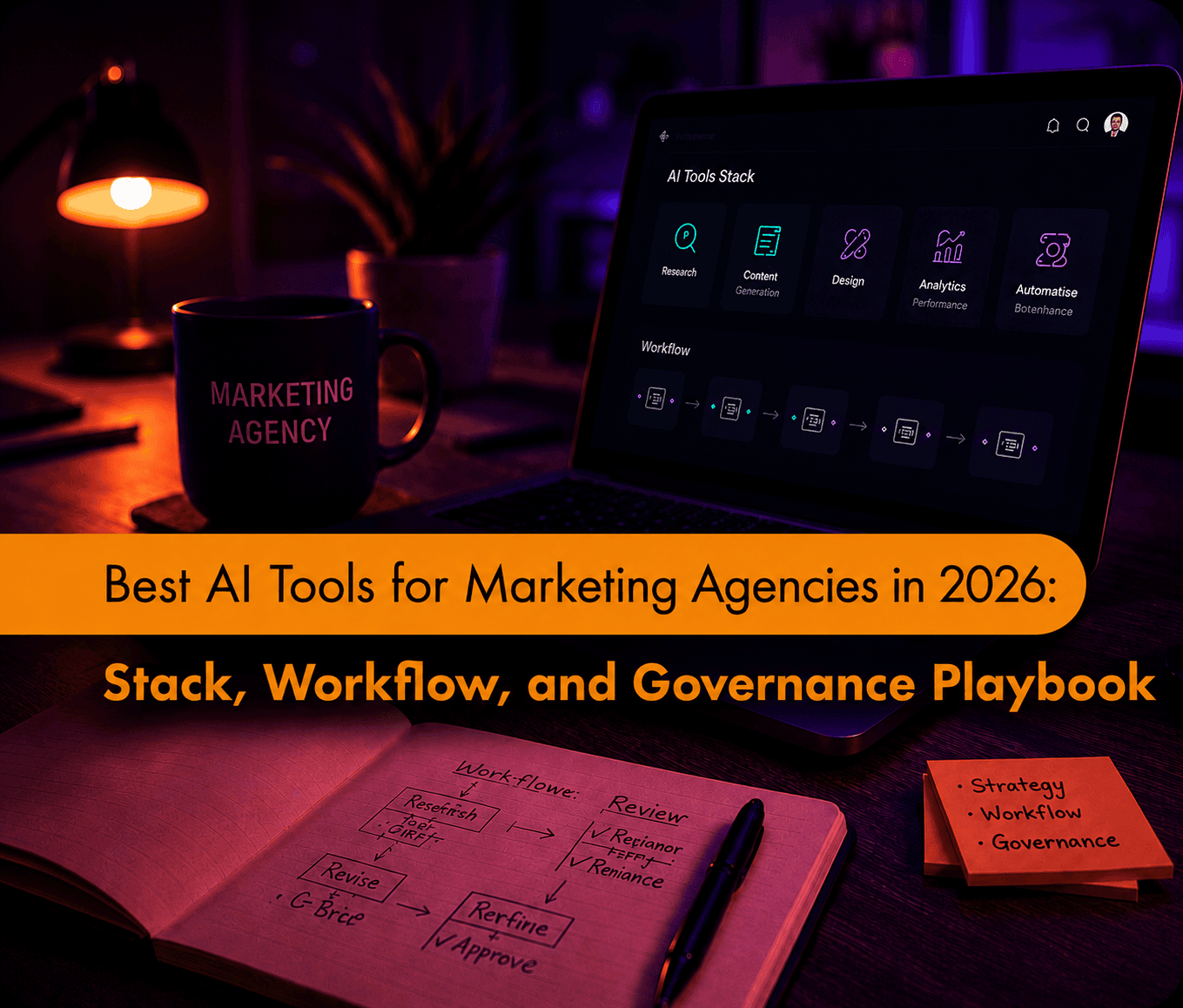
This playbook lays out the 2026 stack by category, names the leaders in each, tells you which ones we actually run at Geeks360 and why, gives you an eight-step workflow you can stand up next week, and ends with the governance section most agencies skip until it bites them. No affiliate fluff, no “top 50 tools” listicle that leaves you more confused than when you started.
The best AI tools for a marketing agency are not a single app. They are a stack, a small set of tools that each earn their slot, wired together so the output of one becomes the input of the next.
What are the best AI tools for a marketing agency in 2026?
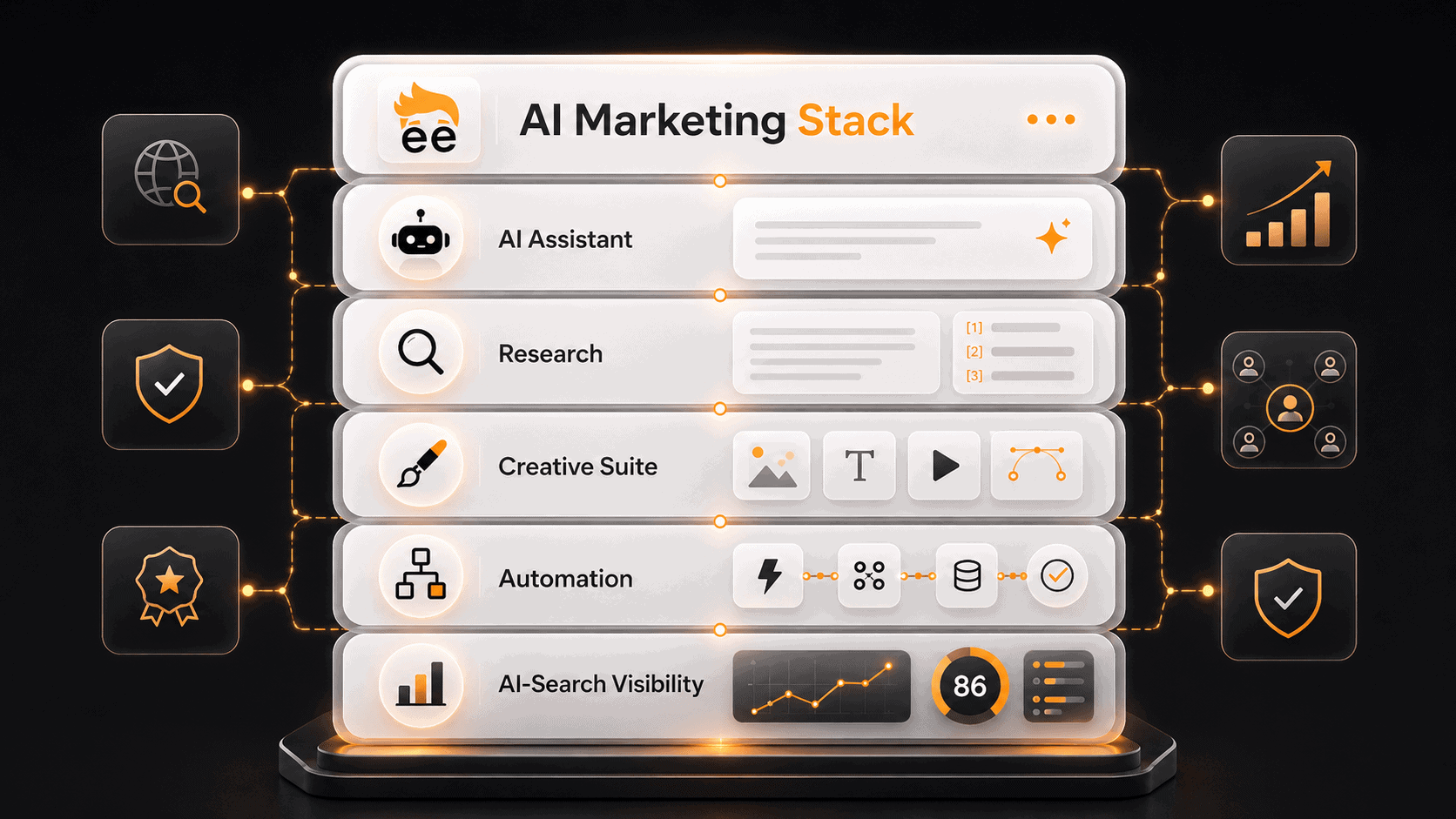
The best AI stack for a marketing agency in 2026 is not one app, it is five layers working together: an AI assistant for drafting and analysis (ChatGPT, Claude), a research engine with citations (Perplexity), a creative suite (Canva, Figma, Adobe Firefly), automation to connect the tools (Zapier, Make, n8n), and AI-search visibility tracking (Atomic and similar) so you can measure whether you show up in AI answers. If you would rather get that baseline done for you – with a fix list attached – you can audit your AI visibility once and go from there. Most agencies need ten to fifteen tools across four or five layers, not fifty. The right question for every tool is simple: Does it improve throughput, quality, or measurability? If not, it is a distraction.
Two numbers explain why this matters more in 2026 than it did even last year:
ChatGPT crossed roughly 900 million weekly active users by early 2026, and Google’s Gemini app reached about 750 million monthly active users, with Gemini reaching over 2 billion people a month through AI Overviews in Search.
Discovery is moving into AI products. Your clients are increasingly found, or not found, inside an answer a model generates, not just on a page of blue links. A stack that cannot produce work for that world, or measure visibility in it, is optimizing for a search era that is shrinking.
How to choose AI tools (before you buy anything)
Tool sprawl is the silent budget killer at agencies. The fix is a filter you apply before every purchase, not after. A tool earns a slot in your stack only if it improves at least one of three things:
Throughput. Faster production, less admin, more output per person without sacrificing quality.
Quality. Better research, stronger positioning, fewer errors, more on-brand work.
Measurability. Clearer attribution, better reporting, a tighter learning loop.
If a shiny new tool does not clearly improve one of those three, it is a distraction wearing a subscription. The other reality of 2026: agents plus automation beat one magic chatbot. The agencies pulling ahead are not the ones with the cleverest single prompt, they are the ones who chained an assistant, a research engine, a design tool, and automation into a repeatable system. That is the difference between experimenting and scaling.
One more principle before the categories, and it is the one most guides bury at the end: buy automation and governance first. It is tempting to start with the fun creative tools. But an assistant speeds up one person, while automation and clear rules scale the whole agency, and keep you out of trouble while doing it. We will come back to governance at the end, because it is that important.
The 2026 stack, layer by layer
Here is the stack by category. For each layer: what it does, the leading tools on the market, and what we run at Geeks360 (with the honest reason why). Your stack will not be identical to ours, and it should not be, the right tools depend on whether you are a content shop, a performance specialist, or full-service. Use this as a map, not a shopping list.
Layer 1: AI assistants (drafting, analysis, thinking)
This is the workhorse layer, the tools your team opens every single day for campaign concepts, messaging, outlines, first drafts, and making sense of long documents. You want one strong generalist assistant, and many agencies run two for different strengths.
Market leaders: ChatGPT (Business/Enterprise) is the default workhorse for fast iteration and team collaboration. Claude is the go-to for long-form drafting, careful synthesis, and working through large documents and research packs without losing the thread.
What we run: ChatGPT and Claude, both. We lean on ChatGPT for quick iteration and Claude for long-form and analysis, the heavier thinking work. For client data, use a Business or Enterprise plan, not a personal account, the data-handling terms are different, and that difference is the whole ballgame (more on that in governance).
Layer 2: On-brand copy at scale
Distinct from the assistant layer: this is for agencies pumping out high volumes of on-brand copy across many channels and many clients, where keeping voice consistent is the hard part.
Market leaders: Jasper is built for marketing teams that need repeatable copy workflows, brand-voice controls, and multi-client content governance. It shines when volume and brand consistency both matter at once.
What we run: We handle most copy through our assistant layer (ChatGPT/Claude) with documented brand-voice prompts, rather than a separate copy platform. That is a deliberate choice for our size, not a knock on Jasper. If you are running on-brand copy across dozens of client accounts, a dedicated brand-voice tool earns its slot fast.
Layer 3: Knowledge and operations
The unglamorous layer that quietly decides how fast your agency actually delivers: where briefs, SOPs, client hubs, and project context live, and how searchable they are.
Market leaders: Notion AI has become the operating layer for many agencies, client hubs, briefs, SOPs, asset libraries, with AI that can answer questions across your whole workspace and write meeting notes.
What we run: Google Workspace (Gemini), Microsoft 365 Copilot, and Notion AI. The principle holds whatever the tool: if your team cannot find the brief, the brand guide, and last quarter’s results in under a minute, that is a throughput problem an AI knowledge layer fixes.
Layer 4: Automation and orchestration (the real scaling lever)
If you only invest deeply in one layer, make it this one. Automation is what turns a pile of good tools into a system, the connective tissue that moves a brief into a draft into a review into a published asset without a human re-typing anything at each step.
Market leaders: Make for complex, visual, multi-step workflows you want full control over. Zapier for fast, simple connections across a huge app library (8,000+ apps) when you just need two tools to talk. n8n for teams that want self-hosted control and maximum flexibility, and are willing to invest a little engineering time up front.
What we run: n8n. We chose self-hosted orchestration for control and flexibility, it lets us build agency-specific workflows (intake to brief, research to draft, reporting packs) that off-the-shelf connectors cannot match. If you have no engineering capacity, start with Zapier; you can graduate to n8n later.
Layer 5: SEO and content optimization
Traditional search still drives real traffic, and on-page optimization at scale is one of the highest-leverage uses of AI for a multi-client agency.
Market leaders: Surfer SEO for structured on-page optimization and content briefs, with AI-search guidelines now baked in. Broader research and audit power comes from Ahrefs, Screaming Frog, and rank trackers.
What we run: Ahrefs for keyword research, backlinks, and content gaps; Screaming Frog for technical crawls and audits; SE Ranking for rank tracking. That trio covers research, technical health, and position monitoring, the three jobs this layer has to do.
Layer 6: Creative production
Where ideas become assets, fast. The bottleneck used to be design capacity; AI moved it to taste and direction.
Market leaders: Canva Magic Studio for rapid social and campaign creative without a heavy design bottleneck. Adobe Firefly for commercially safer image generation with provenance built in. Midjourney for top-tier image quality and brand imagery.
What we run: Claude Design and Figma. Figma is our design home; Claude Design speeds up the path from concept to layout. The lesson here is not our exact pick, it is that creative should sit next to your assistant and automation layers, not in a silo.
Layer 7: Research with citations
Strategy and competitive work need evidence, not vibes. This layer is about getting answers with sources you can actually check and cite to a client.
Market leaders: Perplexity is purpose-built for research with citations and source links, ideal for market research, competitor scanning, and building evidence-based recommendations.
What we run: We run research through our assistant layer with web access and always verify sources by hand before anything reaches a client deck. A dedicated citation-first research tool like Perplexity is a strong add when research volume is high, evidence has to be airtight, and speed matters.
Layer 8: AI-search visibility (GEO)
The newest layer, and the one most agencies have no coverage for yet. If your clients care about being mentioned in AI answers (and with 900M weekly ChatGPT users, they should), you need to measure it, not guess.
Market leaders: Atomic tracks AI-search performance across LLM engines and ties it to SEO workflows. There are several AI-visibility tools emerging, so compare on three things before you buy: engine coverage (which LLMs it tracks), reporting depth (prompt-level vs domain-level), and whether it maps visibility to real outcomes (leads, conversions), not just mentions.
What we run: Atomic, for exactly this, tracking whether we and our clients show up in AI-generated answers across engines. This layer is core to how we think about “Where AI Meets ROI”: visibility you cannot measure is visibility you cannot improve or bill against.
The Geeks360 stack at a glance
Here is the whole thing in one view, market leaders next to what we actually run. Steal the structure, swap the tools to fit your shop.
Layer
Market leaders (2026)
What Geeks360 runs
AI assistant
ChatGPT (Business/Enterprise), Claude, Google Gemini, Microsoft Copilot, Perplexity, Mistral Le Chat, DeepSeek
VWO, Optimizely, AB Tasty, Hotjar, Microsoft Clarity, Unbounce
Microsoft Clarity, Unbounce
Tools are nouns; workflows are verbs. A stack only pays off when it runs as a repeatable system instead of random tool-grabbing. Here is an eight-step flow that turns the layers above into an actual process, from blank brief to measured result. Each handoff is a place where automation can later remove a human copy-paste.
Brief intake (knowledge layer). Capture goals, audience, proof points, and constraints in one place. A good brief is the difference between AI that helps and AI that hallucinates confidently.
Research with citations (Perplexity + human check). Gather sources, competitor patterns, and market signals, then verify them. Never let an unverified stat reach a client.
Messaging and structure (ChatGPT / Claude). Build the messaging matrix, the outline, and the first draft. This is where the assistant layer earns its keep.
On-brand copy production (assistant + brand-voice prompts, or Jasper). Generate channel variants, ads, landing pages, email, social, against documented brand rules.
Optimization (Surfer / Ahrefs). Align structure, entities, and on-page coverage so the work can actually rank and get cited.
Creative assets (Canva / Figma / Claude Design). Produce and format variants for each channel. Keep AI-creative provenance intact (see governance).
Automate the handoffs (Zapier / Make / n8n). Move tasks, files, and approvals through the stack without manual re-entry. This is where the hours come back.
Visibility and reporting (Atomic + analytics). Track performance in both Google and AI-answer surfaces, and tie it back to outcomes. If you cannot measure it, you cannot bill it or improve it.
Governance: the part most agencies skip (and regret)
If you are running AI across multiple clients, the difference between a scalable agency and a lawsuit-in-waiting is governance. This is the section that gets skipped because it is not fun, and it is exactly the section that protects your client relationships, your brand, and your data. Standardize four things before you scale, not after.
Data rules. What is allowed in AI tools and what is never allowed. The hard line: no customer personal data in consumer-grade chatbots (free or personal-tier ChatGPT, Claude, Gemini). Under CCPA and US state privacy laws, a marketer pasting a client’s customer list into a free chatbot is a data-protection problem, not a shortcut.
Brand rules. Voice guidelines, claims standards, required sources, and an explicit ban on AI-generated use of real faces, voices, and third-party IP. AI generators can reproduce a recognizable person or a protected brand by accident, and “the AI did it” is not a defense.
Approval rules. Who signs off before anything publishes. AI accelerates drafting; humans stay responsible for final quality and claims. Define the approval gate before the first campaign, not after the first mistake.
Tool access. Use business or enterprise accounts with admin controls wherever client data is involved. Business-tier plans carry data-handling commitments that personal plans do not, that single distinction covers most of your exposure.
Want the deeper version of this? Our companion guide, the Agentic Marketing Stack Audit, turns governance into a scored 50-point checklist you can run on your own stack in an afternoon. The playbook you are reading now tells you what to buy and how to use it; the audit tells you whether what you are running is safe and measurable. Run both.
Reading the stack is step one. Building yours, and proving it pays, is the part that matters. We turned this whole playbook into a free, ready-to-use Google Sheet. The Stack Planner maps all ten layers, your pick, status, monthly cost, and priority per layer, with gaps and totals calculated for you. The ROI Calculator then shows whether that stack actually pays for itself: time-saved value, net monthly gain, ROI percentage, and payback period, all from six inputs. Plan it, cost it, and make the case in one file.
Download the AI Marketing Stack Planner (+ ROI Calculator)
What are the best AI tools for marketing agencies in 2026?
A strong 2026 stack is not one app, it is layers: an AI assistant (ChatGPT, Claude), research with citations (Perplexity), a design suite (Canva, Figma, Adobe Firefly), automation (Zapier, Make, n8n), SEO optimization (Surfer, Ahrefs), and AI-search visibility tracking (Atomic). Most agencies need ten to fifteen tools across four or five layers, not fifty.
Which AI tool should an agency buy first?
Automation and governance, not a chatbot. A single assistant speeds up one person; workflow automation scales delivery across every client, and clear governance keeps you out of trouble while you do it. Buy the scaling lever and the guardrails first, the fun creative tools second.
How many AI tools does an agency actually need?
Ten to fifteen across four or five layers is typical. The full market has well over a hundred tools, but over-tooling creates integration overhead that erases the productivity gains you bought them for. Apply the filter: throughput, quality, or measurability, or it is a distraction.
Is it safe to use AI tools with client data?
It depends on the plan and your governance. Use business or enterprise accounts (which carry stronger data-handling terms), follow vendor privacy terms, never put customer personal data into consumer-grade tools, and require human approval before publishing. Under CCPA and US state laws, the account tier you use is a compliance decision, not just a budget one.
Do agencies need a dedicated AI-search visibility tool?
If your clients care about being cited in AI answers, yes, you need to measure it. With ChatGPT around 900M weekly users and Gemini reaching billions through AI Overviews, AI answers are a real discovery surface. Choose a tool that covers multiple engines, supports prompt-level analysis, and ties visibility to outcomes.
How do we stop AI content from sounding generic?
Use a documented messaging matrix and brand-voice guide, feed the assistant verified research, and treat AI as a draft engine, not the final author. The generic-sounding output comes from generic input. Specific brief in, specific work out; humans own the final quality and claims.
You just mapped the ten layers. We design an AI stack around your services, your clients, and your data rules, then wire it into a workflow and tie it to ROI. If you would rather have it built with you than assemble it tab by tab, that is exactly the kind of thing we geek out on.






 Previous article


