If you have been burned by an SEO agency before, you are in the majority. The usual story goes like this: a slick pitch, a senior strategist who asks all the right questions, a contract, and then three weeks later a junior account manager you have never met is reading your own analytics back to you on a monthly call while your rankings do nothing. Twelve months and a five-figure spend later, you are exactly where you started, minus the budget.
Fair warning, and we will say it up front: we are an SEO agency. So instead of pretending we are a neutral referee, we are going to tell you exactly how to vet any agency, including us, with the same hard questions. If a provider cannot answer these, walk, even if that provider is wearing our logo. A good agency wants an informed client; only a bad one benefits from a confused one.
Let’s geek it.
It does not have to go that way. Hiring SEO well is not about luck or finding a magic agency; it is about knowing what to ask, what to look for, what to run from, and what a fair deal actually costs. This guide gives you all four.
How do you hire the right SEO agency?
To hire the right SEO agency, vet four things: proof (named case studies with real ROI, and ideally their own brand ranking and cited in AI answers), 2026 capability (a concrete plan for AI Overviews, GEO/AEO, and entity-based optimization, not just keywords), transparency (you own your analytics and data, reporting ties to revenue not vanity metrics), and a fair contract (clear deliverables, performance milestones, an exit clause, no guaranteed-ranking promises). Expect $1,500-5,000 per month for most US small and mid-market businesses, with results in three to six months. Anyone guaranteeing page-one rankings in 30 days is the single clearest red flag in the industry.
Why this matters more in 2026:
Search is splitting between traditional Google results and AI answers (AI Overviews, ChatGPT, Perplexity, Gemini). An agency still running a 2020 keyword-only playbook is optimizing for a search world that is shrinking.
The market is crowded. The US SEO market is roughly an $82 billion industry in 2026, which means plenty of skilled providers and plenty of confident people who will happily take your retainer with no plan to earn it.
Prices went up. About 70% of agencies raised prices in 2025, partly for inflation and partly to reposition around AI-powered search. Knowing the real ranges keeps you from both overpaying and buying suspiciously cheap work.
Freelancer vs agency vs in-house: which fits you?
Before you evaluate any single provider, decide what kind of provider you actually need. Each model trades cost against capacity, control, and risk.
Freelance SEO specialist
Best for short-term projects, technical audits, or small businesses on a tight budget that need targeted help rather than a full ongoing program. Upside: flexible, lower overhead, access to niche specialists. Downside: limited bandwidth, harder to scale, and a single point of failure if that one person disappears. US freelance rates run roughly $50-150 per hour depending on experience.
SEO agency
Best for mid-market to growth-stage companies that need a comprehensive, ongoing program (technical, content, links, local, and now AI-search visibility) under one roof. Upside: process maturity, multiple specialists, a reputation to protect. Downside: higher cost, and some agencies default to cookie-cutter strategies or the senior-sells-junior-delivers bait-and-switch. Vetting (next section) is how you tell the good ones apart.
In-house SEO hire
Best for larger organizations with mature digital teams and long-term goals that justify a full salary. Upside: deep brand knowledge, full-time focus, direct control. Downside: high fixed cost and a single point of failure, when that person leaves, institutional knowledge walks out with them. A US in-house SEO specialist runs roughly $70,000-115,000 per year, before tools and benefits.
Rule of thumb: a freelancer fixes a problem, an agency runs a program, and an in-house hire owns a function. Most growing businesses start with an agency and add in-house oversight later.
How to vet an SEO agency, step by step
Vetting separates genuine experts from convincing salespeople. Work through these four steps with any provider before you sign anything.
Check proof, not promises. Ask for named case studies with specific outcomes, traffic, leads, revenue, conversion, not “we improved visibility.” The sharpest 2026 test: can they show their OWN brand ranking, and cited in AI Overviews or ChatGPT, for competitive terms? An agency that has done it for itself is a different animal from one with only client testimonials.
Ask about their 2026 strategy. Do they have a concrete plan for AI Overviews, zero-click search, and GEO/AEO? Listen for entity-based optimization, topical authority, and branded-search lift, not just “we will write blog posts and build links.” If AI search gets a blank stare, they are behind.
Verify the tool stack and methodology. Real providers use data tools (Ahrefs, Semrush, Screaming Frog, Search Console) and practice white-hat techniques. Ask them to walk you through how they would approach your site. A clear, jargon-free explanation is a green flag; “it’s proprietary” is not.
Check authority and references. Published work, named clients, and a current reference you can actually call. An agency confident in its work will connect you with a client; hesitation here is a signal.
The questions to ask (copy these into your next call)
These are the questions that separate a 2026 agency from a 2020 one. Bring them verbatim.
On methodology
Walk me through your actual strategic approach, not your service list. (Listen for named phases and a logic for sequence, not a menu of deliverables.)
How do you decide what to work on first for a new client? (Impact-based prioritization vs a fixed checklist every client gets.)
Do you take an entity-first or a keyword-first approach?
On AI search capability
Do you have a specific strategy for getting brands cited in AI Overviews and AI answers? (“It happens naturally” is not a strategy.)
Can you show me a client, or your own brand, currently cited in AI answers for competitive queries, with the query and timeline?
How do you track and measure AI-search visibility, not just traditional rankings?
On reporting and transparency
What metrics do you report on, and why those? (Revenue, leads, and pipeline are outcomes; rankings and traffic are inputs.)
Will I have direct, owned access to Google Analytics and Search Console, under my account, not yours?
How do you communicate when an algorithm update hits, do you call me, or do I find out from a traffic drop?
On pricing and contract
What is your pricing model, and what exactly is included each month?
What is the minimum term, and what are the exit terms and cancellation fees?
What happens to my content, data, and accounts if we part ways? (You should own all of it.)
Red flags: walk away if you hear these
Some warning signs are classic; others are specific to how the industry has changed with AI. Every one of these traces back to the same root: a gap between what an agency claims and what it can prove.
Guaranteed rankings. “Page one in 30 days, guaranteed” is the number-one red flag in SEO. Google itself warns against it. No one controls the algorithm; a guarantee means either a lie or black-hat tactics that risk a penalty.
A “proprietary secret” process. Legitimate agencies explain their methodology; the value is in execution, not secrecy. “We have a special network” usually means low-quality paid links that will eventually trigger a penalty.
Senior sells, junior delivers. You meet an impressive strategist in the pitch, then a junior you have never spoken to runs your account. Ask directly who does the work, what their experience is, and what happens if they leave.
Vanity-metric reporting. Reports full of “traffic up 200%” and keyword counts but silent on leads, revenue, or pipeline. Rankings you cannot connect to business outcomes are worthless.
They control your data. Analytics or Search Console set up under the agency’s account, not yours. This is a hostage tactic, when you try to leave, your history leaves with them. Own everything, always.
SEO is one of fifteen services. When SEO is one line item on a giant service menu, it usually means a small, under-resourced team working from an outdated playbook. Specialist depth beats a jack-of-all-trades.
AI-SEO claims with zero proof. The most dangerous 2026 red flag. Everyone added “AI SEO” to their site. Ask for a verifiable AI-Overview citation, query, screenshot, timeline. Vague “AI-powered approach” with no receipts is a buzzword, not a capability.
Long lock-ins with no performance benchmarks. A 12-month term is not automatically bad, SEO takes time, but a long contract with no milestones, no defined KPIs, and no exit if targets are missed protects the agency, not you.
Contract clauses to refuse
The pitch can be perfect and the contract still be a trap. Read for these before you sign, and push back on any that appear.
Ranking guarantees of any kind.
A bundled link-building budget the agency controls with no transparency on sources.
No mention of AI crawlers or GEO/AEO scope at all (a sign of a 2020 playbook).
Content or IP ownership that transfers to, or stays with, the agency.
“Content deliverables” with a count but no quality floor.
Exit-clause asymmetry: they can leave easily, you cannot.
Minimum terms over six months with no performance review gate.
Vague reporting language that hides what is actually being done.
The agency owns your analytics, Search Console, or tracking stack.
A clean contract names the scope (activity and outcome), lists monthly deliverables with quality standards, gives you ownership of content, data, and accounts, sets performance review points, and lets you exit if benchmarks are consistently missed.
What SEO actually costs in the US (2026)
Pricing varies because scope does, a single-location dentist needs something very different from a national e-commerce brand. But here are the real 2026 US ranges so you can sanity-check any proposal. Most established US agencies with a track record charge toward the middle and top of these ranges; suspiciously cheap work usually means fewer hours or lower-quality execution.
US SEO pricing ranges by engagement model, 2026. Actual costs vary by scope, competition, and agency track record.
Pricing model
Typical US range (2026)
Best for
Monthly retainer (small business)
$1,500 – $3,500 / mo
Local and SMB ongoing programs
Monthly retainer (mid-market)
$5,000 – $10,000 / mo
Competitive niches, multi-location, growth
Monthly retainer (enterprise)
$10,000 – $50,000+ / mo
National brands, large sites, high competition
Hourly consulting
$100 – $250 / hr
In-house teams needing expert guidance
One-time project/audit
$2,500 – $30,000
Defined-scope audits or strategy builds
Benchmarks: the average US agency retainer sits around $3,000-3,500 per month (Ahrefs survey data puts it near $3,200); $150/hr is the most common hourly rate. Expect three to six months for initial traction and six to twelve months for significant organic growth. The ROI logic: unlike paid ads that stop the moment you stop paying, SEO is a compounding asset that keeps returning value after the work is done.
What to prioritize by business type
The right agency for you depends on what kind of business you run. Use the lens that fits.
Local / multi-location business
Prioritize providers with real local-SEO depth: Google Business Profile optimization, local citations, review management, and location-page strategy that is not thin doorway content. Ask specifically about a multi-location structure if you have more than one address. Budget: typically $1,500-4,000 per month.
E-commerce brand
Prioritize technical SEO at scale (faceted navigation, product schema, crawl budget), plus an answer to the fact that Amazon and AI shopping answers now compete for product discovery. Ask how they handle programmatic product and category pages without triggering thin-content penalties. Budget: mid-market ranges and up.
B2B / SaaS
Prioritize topical authority, bottom-of-funnel commercial-intent content, and entity positioning so you get cited in AI answers when buyers research solutions. Lead quality beats raw traffic here; make sure reporting ties to pipeline, not pageviews. Budget: $3,000-5,000+ per month for competitive categories.
Score your shortlist before you decide
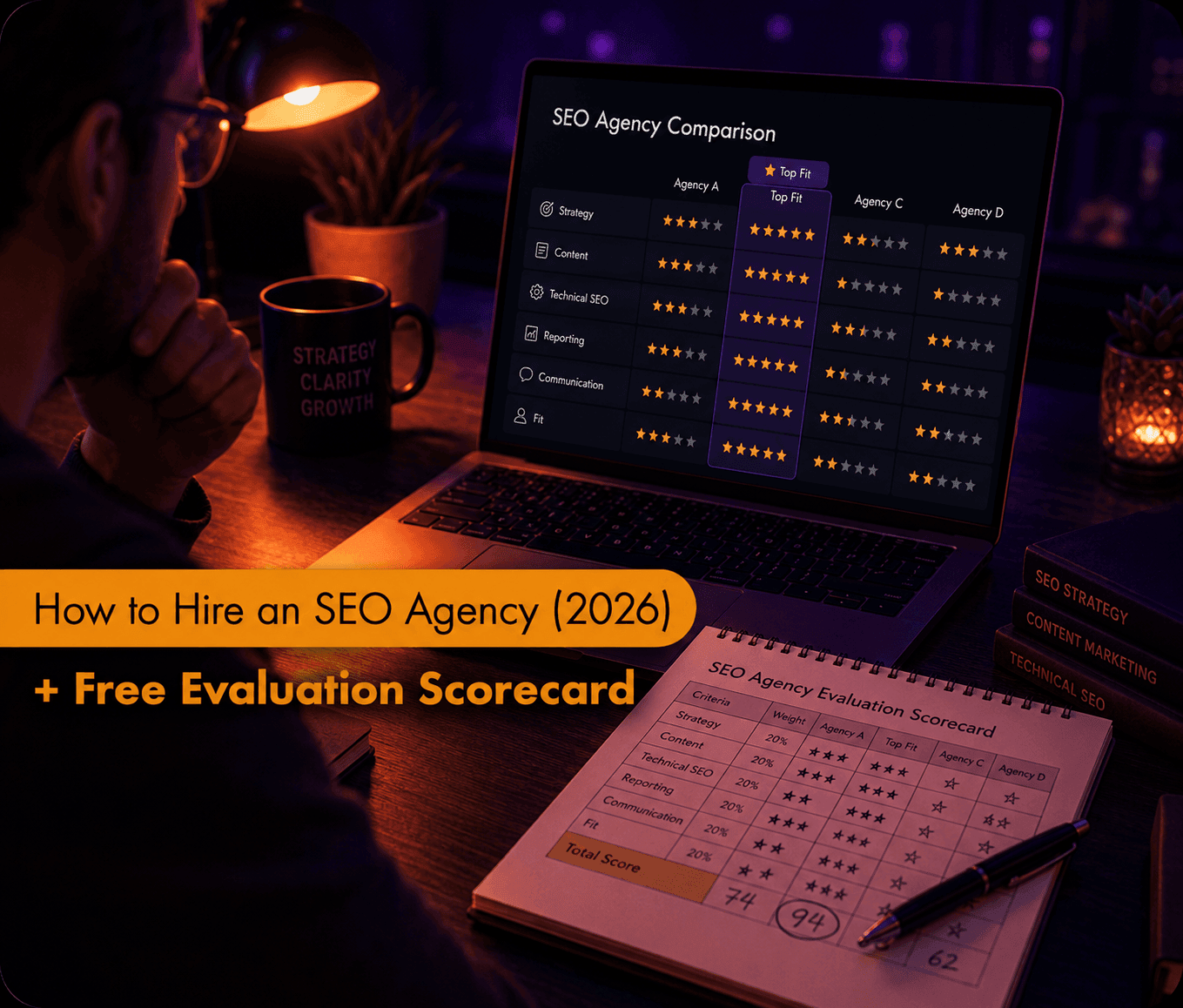
Gut feel leads to expensive mistakes. The fairest way to compare two or three agencies is a weighted scorecard: rate each on methodology, AI-search capability, proof, reporting, content and links, and contract terms, then let the numbers, not the best sales presentation, guide you.
We built exactly that into a free, ready-to-use tool. Download the SEO Agency Evaluation Scorecard, score each agency on the dimensions that actually predict results, and get an objective comparison in one sheet, including a red-flag checklist to run against each proposal.
How much does it cost to hire an SEO agency in 2026?
Most US small and mid-market businesses pay $1,500-5,000 per month on a retainer, with the average around $3,200. Mid-market competitive programs run $5,000-10,000, and enterprise $10,000-50,000+. Hourly consulting is $100-250, and one-time projects are $2,500-30,000. Suspiciously cheap work usually means fewer hours or lower quality.
How long until SEO shows results?
Typically three to six months for initial traction and six to twelve months for significant organic growth. Anyone promising faster, especially guaranteed page-one rankings in 30 days, is either misleading you or using tactics that risk a penalty.
What is the biggest red flag when hiring an SEO agency?
Guaranteed rankings. No one controls Google's algorithm, so a guarantee means either a lie or black-hat tactics that can get your site penalized. Google itself advises against working with anyone who guarantees rankings.
Should I hire a freelancer, an agency, or go in-house?
A freelancer fixes a specific problem or runs a small program; an agency runs a comprehensive ongoing program with multiple specialists; an in-house hire owns the function full-time but is a high fixed cost and single point of failure. Most growing businesses start with an agency.
What questions should I ask an SEO agency before hiring?
Ask them to walk through their methodology (not their service list), show their own brand or a client cited in AI answers, confirm you own your analytics and Search Console, explain how they measure success in revenue and leads, and lay out contract term, exit terms, and data ownership.
Do SEO agencies need to handle AI search now?
Yes. With search splitting between Google results and AI answers (AI Overviews, ChatGPT, Perplexity, Gemini), any agency without a concrete GEO/AEO and entity-optimization strategy is working from an outdated playbook. Ask for proof they can get brands cited in AI answers, not just ranked.
Geeks360 SM is a full-service social media marketing agency helping business owners & entrepreneurs use social media and digital marketing in order to find, connect and convert audiences into followers, clients and customers.




 Previous article


