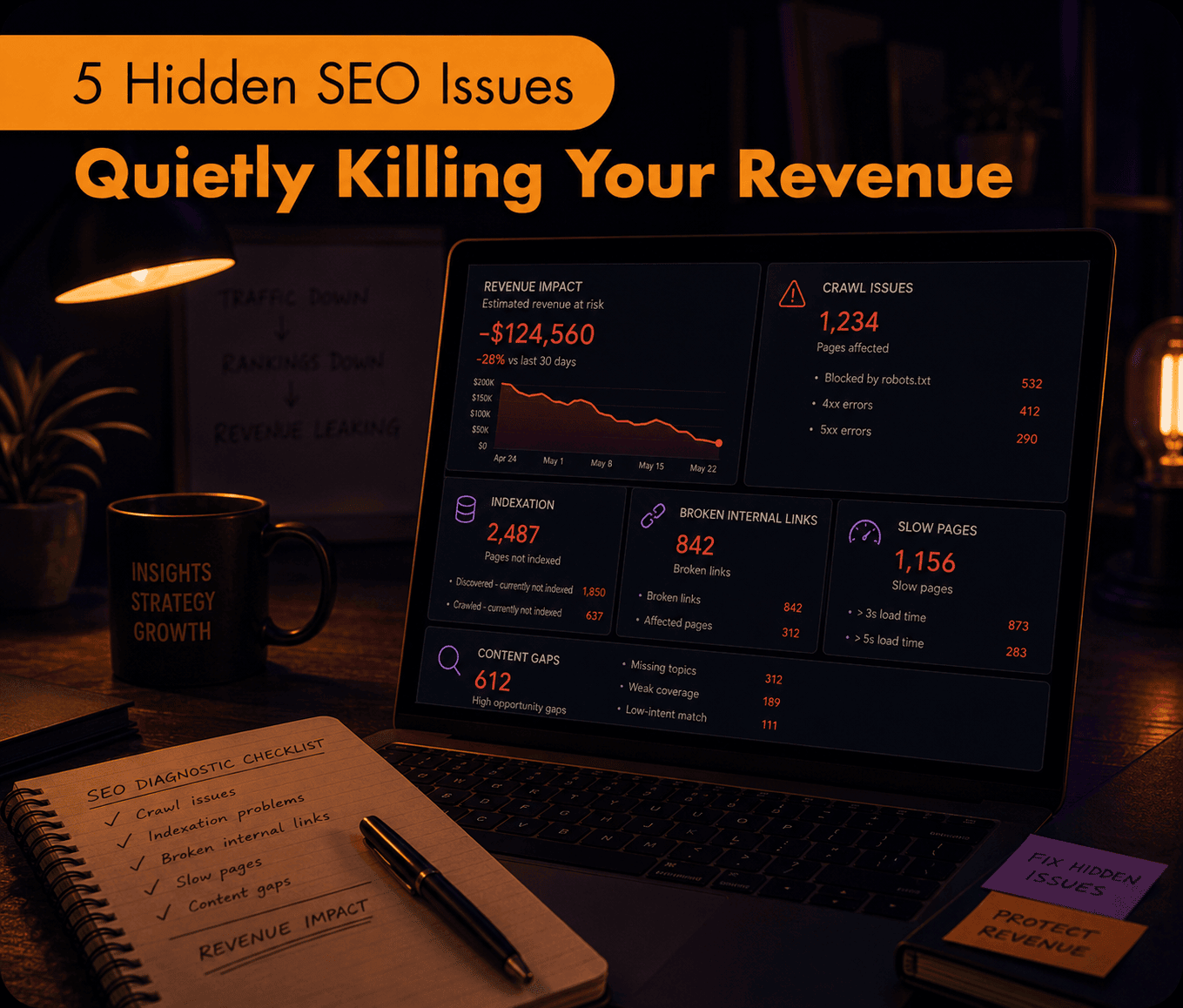
The SEO problems that hurt your revenue the most are rarely the ones you see in a tool dashboard. They are the slow leaks – patterns that compound over months, miss every alert threshold, and only become visible when revenue is already down. This article walks through five of the most common hidden issues we surface during audits, why they happen, and how a structured audit catches them before they become quarterly losses.
1. Indexation Drift After a CMS Migration
You migrated platforms two years ago. Traffic dipped, recovered, and you moved on. But Google now indexes 40% more URLs than you intended. Every parameter URL, every old archive page, every soft 404 is still in the index. Crawl budget is spread thin. Your important pages get crawled less often. New product pages take weeks to be reindexed.
This is one of the most common patterns in enterprise SEO audits – especially for sites with 10,000+ URLs where indexation problems compound silently.
Crawl budget is something you should worry about if you have a really large website.
AuthorJohn Mueller, Google
How an audit catches it: indexation coverage report segmented by template, soft 404 detection, server log analysis showing where Googlebot is wasting time.
2. Schema Markup Broken After a Theme Update
Your theme auto-generated Product, Review, and FAQ schema. It worked. Then your developer pushed a routine theme update last quarter and now half your rich snippets are gone. Click-through rate dropped 18% on product pages, but no one connected it to schema because tools still report “schema present.”
This is the most common silent leak we find on e-commerce sites. According to Moz research, structured data implementation issues affect a significant share of audited e-commerce stores.
How an audit catches it: schema validation across templates (not just one sample page), Rich Results Test on all key page types, GSC Enhancement reports cross-checked against actual SERP appearance. Our e-commerce SEO audit runs this check on every product and category template.
3. Keyword Cannibalization Between Product, Category, and Blog
Your blog ranks for “best running shoes for flat feet.” So does your category page. So does a product description. Google rotates between them, ranking each one inconsistently, and aggregate traffic is lower than if any single page held the position.
This happens most often when content, product, and SEO teams work in silos. The blog team writes about a topic the category page already targets. The product team optimizes for the same query the blog ranks for.
“Pages competing for the same query end up hurting each other.” – Aleyda Solis
How an audit catches it: keyword cannibalization report cross-referencing GSC queries against URL data, internal linking equity analysis, content gap matrix.
Worried Your Site Has Hidden Leaks?
These five issues cost businesses thousands in lost revenue every month – and most teams never spot them. Send us your domain and we will run the diagnostic that catches them.
4. Out-of-Stock Products Still Ranking and Sending Users to Dead Pages
For e-commerce sites, this is brutal. A product that ranked #2 for a high-volume query is now out of stock. Your CMS keeps the page live but with an “Out of Stock” message. Google still ranks it. Users still click. Then they bounce. Conversion rate drops, bounce rate spikes, and the page slowly loses ranking – taking the category page with it as internal links lose context.
According to Search Engine Journal, out-of-stock product handling is one of the most underdiagnosed e-commerce SEO issues.
How an audit catches it: out-of-stock SKU inventory check, conversion rate analysis on product pages, recommendation matrix for redirect, similar-product display, or back-in-stock notification flow.
5. AI Search Invisibility (The New Hidden Issue)
Your brand does not appear in ChatGPT shopping queries. Perplexity cites your competitors. Google AI Overviews skip you entirely. You did not see this drop in GSC because AI search traffic is not yet fully reported there. But your branded mentions on these surfaces are below replacement level.
How an audit catches it: AEO and GEO visibility tracking across ChatGPT, Perplexity, Gemini, and Google AI Overviews; schema readiness for AI crawlers; brand entity coverage analysis. All three of our audits – standard, enterprise, e-commerce – now include AEO assessment as a core layer.
Why These Issues Are Hidden
The pattern across all five: they do not trigger alerts. They do not show up as red errors in tool dashboards. They often look fine in spot checks. The only way to catch them is structured analysis across templates, against revenue data, with manual interpretation. That is what an audit is for.
If your last audit was a tool-generated PDF with a list of issues, it almost certainly missed at least three of these.
Beyond Diagnosis: What to Do Next
Diagnosing the leak is half the work. Closing it is the other half. Once an audit identifies what is broken, the fix often spans multiple disciplines – dev for technical work, content for cannibalization, CRO for the bridge between traffic and revenue, paid ads to maintain volume during fix implementation. We coordinate across all of them at Geeks360, so the audit roadmap turns into actual revenue recovery.
The SEO issues that quietly drain revenue are rarely the ones tools flag. They are slow leaks – indexation drift, broken schema after theme updates, keyword cannibalization, out-of-stock product handling, and AI search invisibility. A structured audit catches them. A checklist tool does not. Pick the audit scope that fits your site – standard, enterprise, or e-commerce – and start with the leaks costing you the most.
Frequently Asked Questions
How do I know if my SEO has hidden issues?
The clearest signals: organic traffic is flat or declining despite content production, click-through rates dropped without a corresponding ranking change, conversion rate is lower on organic traffic than paid traffic, or your competitors are gaining market share you cannot explain. None of these will trigger alerts in tools. They surface only through structured analysis - which is what a proper SEO audit is designed to find.
Why do most SEO tools miss these issues?
Tools are designed to surface coverage, not priority. They flag everything that looks broken without telling you which issues actually cost you revenue. They also miss issues that require manual interpretation - like detecting whether your category page and blog are cannibalizing each other, or whether your schema is technically present but rendering incorrectly. Manual expert review is where these issues get caught.
How does a CMS migration cause indexation drift?
When you migrate platforms, redirect rules often miss edge cases - parameter URLs, archive pages, search result pages, old taxonomy URLs. Google keeps indexing them. Over time, your indexable URL count grows beyond what you intended. Crawl budget gets spread thin across pages that should not be in the index, and your important pages get crawled less often. This is one of the most common findings in our enterprise SEO audits.
What should I do with out-of-stock product pages?
It depends on the situation. For permanently discontinued products, redirect to the closest similar product or the parent category. For temporarily out-of-stock items, keep the page but add structured "back in stock" notification, related products, and Schema.org availability markup signaling out-of-stock status. Never just leave the page live with no signal - that destroys conversion rate and eventually rankings. Our CRO services often pair with e-commerce audits on this exact issue.
How do I check if my brand appears in AI search?
Run your most important commercial queries directly in ChatGPT, Perplexity, Gemini, and check Google AI Overviews. Note which sources get cited - usually a handful of authoritative sites repeat across queries. If your brand is missing from queries where you should appear, you have an AEO and GEO visibility gap. Fixing it requires schema readiness for AI crawlers, llms.txt setup, and entity coverage work - covered in all three of our audit types.
Geeks360 SM is a full-service marketing agency helping business owners & entrepreneurs use Local SEO and digital marketing in order to find, connect and convert audiences into followers, clients and customers.






 Previous article


