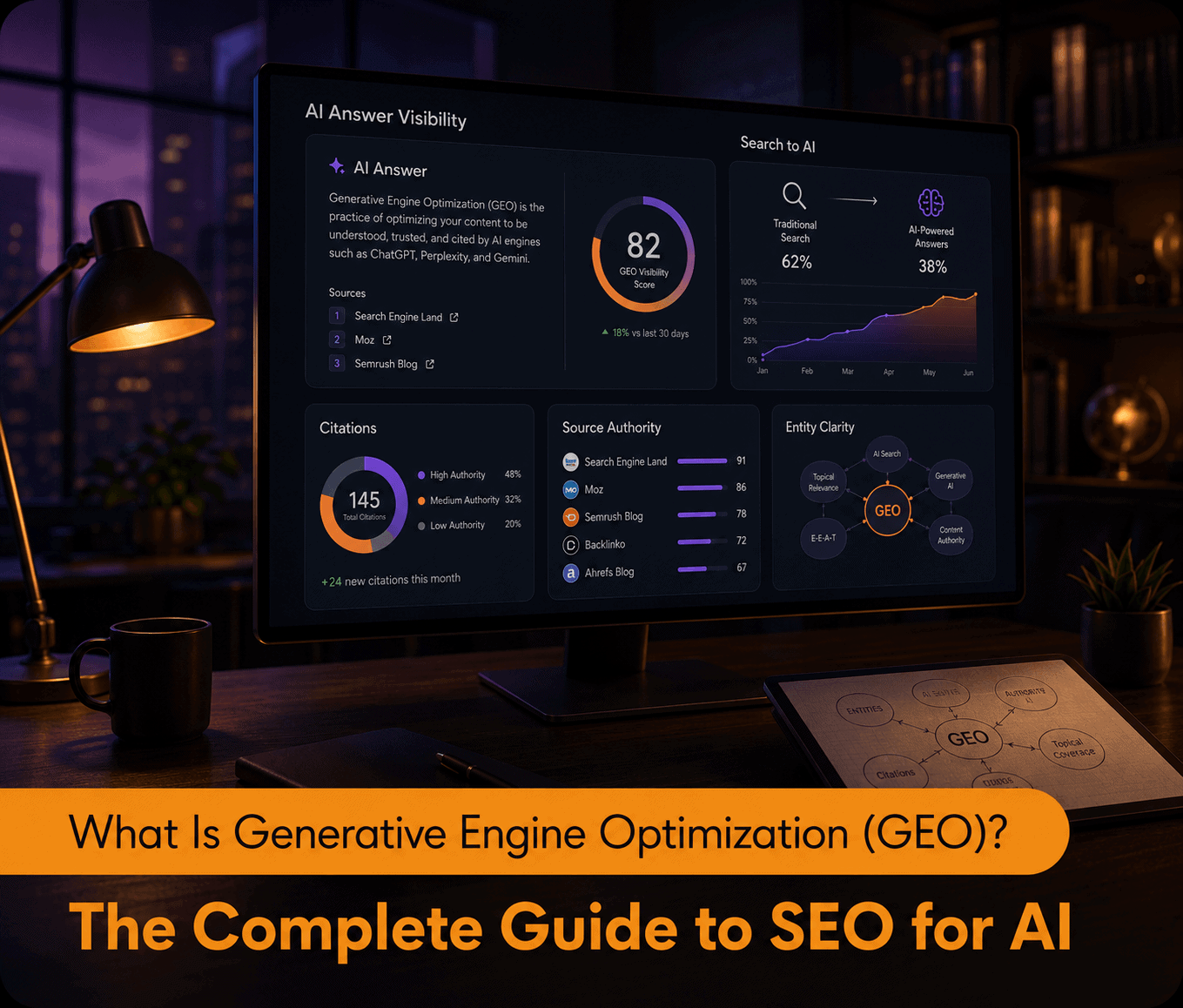
Generative Engine Optimization (GEO) is the practice of optimizing your brand and content so generative AI engines – ChatGPT, Google Gemini, Perplexity, Google AI Overviews, and Microsoft Copilot – understand, trust, recommend, and cite you in their answers. Put simply, GEO is SEO for AI: instead of competing only for rankings on a results page, you compete to be the source the AI repeats when someone asks a question.
The term comes from academic research into how large language models select and cite sources, and it has quickly become a core part of modern search strategy. This guide covers what GEO is, what it stands for, how generative engines work, how GEO compares to SEO and AEO, and a practical playbook to start earning AI citations.
What is GEO and what does it stand for?
GEO stands for Generative Engine Optimization. A generative engine is an AI system that generates an original, synthesized answer to a query rather than returning a list of links. GEO is the set of techniques that make your content the trusted, quotable source those systems draw from.
Note that GEO is also an abbreviation for geographic in other contexts. In the world of search and AI, GEO means Generative Engine Optimization. It is closely related to Answer Engine Optimization (AEO), and the two terms are often used interchangeably.
GEO is not separate from SEO. It is the next chapter of it: the same authority and clarity that rank a page are what make an AI quote it.
Why GEO matters: search is moving into AI
Zero-click is normal. When the answer is delivered in chat or in an AI Overview, the brands cited inside it win the attention.
Recommendations happen in the model. Best [category] and [brand] vs [competitor] questions are increasingly answered by AI, not by a results page.
Early influence compounds. Being cited during research shapes which vendors a buyer ever considers.
How generative engines work (and how GEO works with them)
Generative engines retrieve relevant, trustworthy information, synthesize it into an answer, and often cite the sources they used. They favor content that is clear, factually consistent, well-structured, and tied to a credible entity. GEO aligns your brand with those preferences:
Entity authority – make it unmistakable who you are and why you are credible.
Answer-ready content – comparisons, buyer-question hubs, and original data models can quote.
Structured data – schema markup that helps machines interpret your content.
Citations and digital PR – references on the third-party sources AI answers lean on.
GEO vs SEO: what is the difference?
Aspect
SEO
GEO
Goal
Rank a page in search results
Be cited and recommended inside AI answers
Surface
Google and Bing results pages
ChatGPT, Gemini, Perplexity, AI Overviews, Copilot
Optimizes for
Crawlers and ranking algorithms
Large language models and retrieval systems
Measured by
Rankings, traffic, clicks
Citations, share of voice, AI-sourced traffic
GEO does not replace SEO. Generative engines lean on the same authority and technical signals that drive Google rankings, so a strong SEO foundation makes GEO far more effective.
GEO vs AEO: are they different?
They overlap so much that many teams treat them as one discipline. GEO emphasizes optimizing for generative models that write answers; AEO emphasizes structured, answer-first content for answer engines and AI Overviews. The work is largely shared. See our guide to what AEO is.
SEO for AI: what actually changes
From keywords to prompts – optimize for natural-language questions buyers ask.
From pages to passages – engines lift self-contained, quotable passages.
From rankings to citations – success is being named, measured as AI share of voice.
From clicks to influence – value is created even without a click, by shaping the answer.
How to do GEO: a practical playbook
Baseline AI visibility. Measure how often each engine mentions and cites you.
Build entity authority. Make your brand identity consistent and credible across the web.
Implement structured data. Add and validate Organization, Product, Service, FAQPage, and HowTo schema.
Earn citations via digital PR on the sources AI answers rely on.
Confirm AI crawler access for GPTBot, Google-Extended, PerplexityBot, and ClaudeBot. Adding an llms.txt file is optional here – it is cheap, but no engine has confirmed it reads one yet.
No – it extends it. Google itself frames optimizing for AI features as an evolution of SEO, not a replacement, and generative engines depend on the same authority and quality signals. The brands that win treat SEO, AEO, and GEO as one connected strategy. For a real example of GEO and SEO working together, see our AI visibility case study – a Beverly Hills clinic that grew from roughly 19 to 182 AI citations while improving its search rankings.
How to measure GEO
GEO is measured by AI share of voice, citation counts by engine, sentiment, and the traffic and conversions arriving from AI sources. Tools such as Semrush AI visibility tooling, Ahrefs Brand Radar, Profound, and Otterly.ai track presence; GA4 plus your CRM connect it to pipeline.
GEO stands for Generative Engine Optimization - optimizing your brand and content so generative AI engines like ChatGPT, Gemini, and Perplexity understand, recommend, and cite you.
What is GEO in simple terms?
GEO is SEO for AI. Instead of only competing for a ranked link, you make your content the trusted source an AI repeats and cites when it answers a question.
What is the difference between GEO and SEO?
SEO aims to rank a page in search results; GEO aims to be cited and recommended inside AI answers. They share the same foundation and work best together.
What is the difference between GEO and AEO?
They overlap heavily. GEO emphasizes optimizing for generative models; AEO emphasizes answer-first content and schema for answer engines. Most programs run them as one discipline.
Is GEO the same as SEO for AI?
Yes, SEO for AI is a common plain-language way to describe GEO. The SEO foundations carry over while the target expands to AI-generated answers and citations.
Will GEO replace SEO?
No. Generative engines rely on the same authority and quality signals SEO builds, and Google frames AI optimization as an evolution of SEO. The two are complementary.
You just mapped the ten layers. We design an AI stack around your services, your clients, and your data rules, then wire it into a workflow and tie it to ROI. If you would rather have it built with you than assemble it tab by tab, that is exactly the kind of thing we geek out on.




 Previous article


