You bought the AI tools. You wired up the agents. Something is humming away in HubSpot, something else is drafting emails in Klaviyo, and there is almost certainly a marketer on your team quietly running half their workflow through ChatGPT. Congrats, you have an agentic marketing stack.
Now answer one question: can you prove it is safe, accurate, and actually making you money?
If you paused, you are not alone, and that pause is the entire point of this guide. The hard part of AI in 2026 was never buying the tools. It is knowing what you are running, whether it works, and whether it is quietly creating a compliance or trust problem while it saves you twenty minutes a day. This is a 50-point audit you can run in one sitting to find out exactly where you stand.
Almost everyone is using agents, almost nobody can prove they are governed or profitable, and the gap between those two facts is where careers and budgets go to die.
What is an agentic marketing stack audit?
An agentic marketing stack audit is a structured review of every AI agent, LLM-powered tool, and autonomous workflow running in your marketing operation, scored across inventory, integrations, evaluation, governance, content provenance, attribution, and ROI. It tells you whether your AI is production-ready or quietly accumulating risk. The bottleneck in 2026 is not tooling, it is the governance and testing discipline to scale agents responsibly. This checklist closes that gap in about three to four hours.
The numbers that should make you run this audit:
Fewer than 15% of organizations will actually enable agentic features in 2026, and the bottleneck is governance and testing, not tools (Forrester).
80% of Fortune 500 companies use AI agents, but only about 25% have governance frameworks that match their adoption pace (NIST/CAISI, February 2026).
Fewer than 40% of marketing teams can prove the return on their AI investments (Hovi Digital Lab, 2026).
82% of organizations now use AI in at least one function, and for the first time since 2018, marketing and sales is the most-cited one (McKinsey, 2026).
Translation: almost everyone is using agents, almost nobody can prove they are governed or profitable, and the gap between those two facts is where careers and budgets go to die. This guide is the map out.
Why this audit exists (the governance gap)
“Almost everyone is using agents, almost nobody can prove they are governed or profitable, and the gap between those two facts is where careers and budgets go to die.”
There is a canyon between “we have AI agents” and “we have AI agents running in production with governance, evals, and proof of ROI.” McKinsey’s 2026 read on the market puts hard numbers on that canyon: 82% of organizations use AI somewhere, but only 23% are actually scaling agentic AI. Another 39% are still experimenting and 38% have not really started. The winners are not the teams with the most tools. They are the teams that can answer “what is running, is it working, and is it safe?” without flinching.
Here is the part most marketing teams underestimate: the pressure is regulatory now, not just operational. In the US, the NIST AI Agent Standards Initiative launched under the CAISI framework in February 2026, and enterprise procurement teams are already using it to vet vendors. Layer on CCPA and the growing patchwork of US state privacy laws, and “we let a marketer paste customer data into a free chatbot” stops being a productivity hack and becomes a data-protection problem with your name on it.
And if you are a small or mid-sized business, this is sharper for you, not softer. Enterprises have legal teams, compliance officers, and a CISO who loses sleep so you do not have to. You have a marketing lead wearing four hats and a Zapier account with admin access to everything. The governance gap is widest exactly where there is no one whose job is to close it. That is not a reason to panic, it is a reason to run a checklist.
A note from our side of the desk. We ran our own stack through this exact audit before publishing it, because telling you to do something we had not done ourselves would be peak agency nonsense. We will show you our real score, warts and all, in the “How to read your score” section. Spoiler: we are not at 100, and neither is anyone honest.
How the scoring works (the blast-radius method)
Most checklists treat every box as equal. This one does not, because a missing document and a customer-data leak are not the same kind of problem. Every one of the 50 items carries a weight of 1, 2, or 3 based on its blast radius, how much damage a “no” does if it fails in production.
Weight 1, documentation and hygiene. Annoying, creates technical debt, unlikely to blow up this quarter. Fix it in your next sprint.
Weight 2, operational risk. A silent failure mode that degrades output or quietly corrupts data across everything an agent touches. Fix it this quarter.
Weight 3, compliance and trust incident. The kind of “no” that becomes a data-protection violation, a regulatory exposure, or a public trust event. Fix it before the agent goes anywhere near production.
How to score: Give yourself 1 point for every “yes,” just binary, no half credit. The weights tell you which “no” answers to fix first, and they set the maximum points available in each section. Total possible: 100 points across all 50 items.
Score
Maturity band
What it means
0-39
Pre-flight
Not safe to scale agents yet. Triage weight-3 items first, today.
40-69
Building
Foundational gaps that will cause incidents at scale. Work weight-2 items by section.
70-89
Production-ready
You are operating responsibly. Polish weight-1 items and re-audit quarterly.
90-100
Best-in-class
You are ahead of 85% of the market. Focus on innovation and sharing what you know.
Section 1: Agent inventory (7 items)
Ask a marketing team “how many AI agents are you running?” and the honest answer is almost always higher than the number they say out loud. Because for every agent IT knows about, there is a “shadow agent”, a clever workflow someone built in a personal ChatGPT account, a Claude project, an n8n flow, or a consumer Zapier, that nobody wrote down. You cannot govern what you cannot see. This section is the flashlight.
1.1 Documented agent register [weight 1]
Do you keep a living register of every AI agent, LLM-powered tool, and autonomous workflow active in marketing? It has to include vendor-platform agents (HubSpot Breeze, Klaviyo K:AI, Salesforce Agentforce) and homemade workflows (n8n, Zapier, Make), and it has to be a document people actually update.
1.2 Owner, purpose, and review date per agent [weight 1]
Does each agent have a named human owner, a plain-English business purpose, and a date it was last reviewed? Without an owner, nobody answers the alarm when an agent goes sideways. Without a review date, agents quietly drift past the job they were built for.
1.3 Model and vendor dependency map [weight 2]
For each agent, do you know which model and vendor it leans on, Claude, GPT, Gemini, or something in-house? When a vendor changes a model or a deprecation date, your agent’s output changes with it. If you do not know the dependency, you cannot manage the surprise.
1.4 Shadow agents identified [weight 2]
Have you actually gone hunting for the agents nobody approved, personal ChatGPT or Claude accounts, self-hosted n8n, consumer Zapier? These process brand and customer data outside any data agreement or access control.
1.5 GA vs beta classification per agent [weight 1]
Do you know which agents are generally available versus beta or experimental? Running a beta agent in a production workflow without flagging it as beta is a quiet operational gamble.
1.6 Agent retirement process [weight 1]
When an agent is no longer used, is there a real process to kill it, revoke credentials, clean up integrations, update the register? Zombie agents with live API keys are an open door long after everyone forgot they exist.
1.7 Quarterly re-inventory cadence [weight 2]
Do you re-inventory the register at least every quarter? A register last touched six months ago is already lying to you. Quarterly is the floor; monthly is smart once you pass ten agents.
Section 2: Tool integrations (8 items)
Here is the failure mode that ruins a good week: your agent works perfectly in testing, then silently produces garbage in production because the CRM sync broke three days ago and it has been reading stale data ever since. Integrations are the plumbing. When the plumbing leaks, the agent does not throw an error, it confidently does the wrong thing.
2.1 Single source of truth [weight 2]
Do all your marketing agents read from and write to one source of truth, a CRM or CDP, instead of five disconnected silos? Agents reading from different sources produce inconsistent personalization; agents writing to different places create duplicate records and attribution holes.
2.2 One identity graph across CRM, ESP, and CMS [weight 2]
Are your CRM, email platform, and CMS tied to the same customer identity? Without it, an agent can fire a win-back campaign at someone who churned in the CRM but still looks active in the email tool.
2.3 Vendor-native agents preferred over bolt-ons [weight 1]
Do you reach for native agents before bolting on a third party? Native agents come with maintained integrations and built-in guardrails. Every bolt-on adds a maintenance surface and one more place your customer data passes through.
2.4 API key and OAuth scope documentation [weight 2]
Have you written down every API key, OAuth scope, and webhook your agents use, and do those scopes follow least privilege? An agent that reads contacts should not hold a permission that lets it delete them.
2.5 Integration health monitoring and alerting [weight 1]
Are integrations watched for failure, with alerts when a sync breaks? A broken sync can quietly corrupt the audience segments your agents rely on for days before a human notices.
2.6 MCP or equivalent for cross-agent tool calling [weight 2]
Do your agents call tools and data through a standard interface like Model Context Protocol rather than a tangle of custom point-to-point glue code? Standardized interfaces survive vendor API changes; custom glue breaks on a Friday.
2.7 Credential rotation schedule [weight 1]
Are API keys, tokens, and webhook secrets rotated on a defined schedule? Static credentials that never change are a slow-motion security risk. Where your platform supports automatic rotation, turn it on.
2.8 Single integration health dashboard [weight 1]
Is there one screen that shows the health of every agent integration at a glance? Without it, checking for failures means manually digging through individual platform logs, which means nobody does it until something is on fire.
Section 3: Eval and test framework (7 items)
This is the section where almost every marketing team scores lowest, so if you bomb it, you are in good company, but do not stay there. “The output looks good” is a vibe, not an evaluation. The whole promise of agents is scale, and scale means a quietly degraded prompt does not produce one bad email, it produces fifty thousand bad emails before anyone notices.
3.1 Evaluation rubric per production agent [weight 3]
Does every production agent have a real rubric, specific quality dimensions scored 1 to 5, not “seems fine to me”? Score what matters: factual accuracy, brand voice, personalization depth, CTA clarity, compliance. A customer-facing agent with no quality gate is an incident waiting for a date.
3.2 Automated regression tests before prompt deployment [weight 2]
Do you run automated tests against a fixed test set before pushing a new prompt or model? A prompt tweak that looks harmless in isolation can swing tone, format, or accuracy at scale.
3.3 LLM-as-judge with a human-calibrated gold set [weight 2]
Do you use an LLM to evaluate outputs at scale, with chain-of-thought reasoning, calibrated against human-labeled examples? Done right, automated judging agrees with human reviewers around 85% of the time.
Are your prompts version-controlled, the way code is? Prompts living in Slack threads cannot be rolled back when a change degrades output.
3.5 A/B testing agent output vs a human baseline [weight 2]
Do you test agent-generated work against human-written work on a real sample? Without a baseline, you do not know whether the agent is adding value or subtracting it. Measure the outcome that matters.
3.6 Agent drift monitoring [weight 2]
Do you watch for drift, quality decaying over time with no deliberate change on your end? Catch it by periodically re-scoring against your original gold set.
3.7 Red-team / adversarial testing [weight 1]
Have you tried to break each customer-facing agent in the last 90 days, prompting it toward harmful, off-brand, or false output the way a determined user would?
Section 4: Governance and access (8 items)
This is the compliance section, and it is where the heavy weight-3 items cluster, because the failures here are not “oops, redo the email,” they are “now we are having a conversation with legal.” Good news: most of this is policy and access discipline, not rocket science. You just have to actually write it down and turn it on.
4.1 Written AI usage policy [weight 3]
Is there a written policy naming approved vendors, prohibited use cases, and data-handling rules? This is the document every other governance item points back to. No policy means no standard to audit against and nothing to hand a regulator who asks.
4.2 AI vendors in your procurement / data-agreement registry [weight 2]
Are all your marketing AI vendors logged with proper data agreements? Native agents process customer data on your behalf; under CCPA that requires a service-provider agreement.
4.3 No customer PII in consumer-grade LLM tools [weight 3]
Have you confirmed that no customer personal data flows into free or personal-tier chatbots? A marketer pasting a customer segment into a free chatbot is a data-protection problem dressed up as a time-saver.
4.4 Role-based access controls on agents [weight 2]
Can just anyone deploy a customer-facing agent, or are there real permissions? Separate who can build, deploy, and modify, and split customer-facing from internal-only.
4.5 Agent action logging with user identity [weight 2]
Are agent actions logged with who triggered them, when, and what came out? Logs without identity make incident investigation impossible.
4.6 Documented escalation path for harmful output [weight 2]
When an agent produces something harmful or wrong, is there a written path, who gets notified, response-time expectation, who can hit the kill switch? Test it before your first production deployment.
4.7 Mapped to NIST AI Agent Standards / CAISI [weight 2]
Have you mapped your agents to the NIST AI Agent Standards framework (launched under CAISI in February 2026)? If you sell to bigger companies, this is becoming a procurement gate. (Selling into the EU? You also have EU AI Act transparency obligations landing August 2, 2026, out of scope for this US checklist, but put it on your radar.)
4.8 Agent owners trained on the framework [weight 1]
Are the people who own agents actually trained on what NIST/CAISI expects? An owner who has never heard of the framework cannot align an agent to it.
Section 5: Content provenance (6 items)
AI makes the creative now, a lot of it. Provenance is the boring-but-load-bearing discipline of being able to prove what was AI-made, keep that proof attached, and stay on the right side of US truth-in-advertising expectations. Skip it and you will eventually ship a deepfaked-looking face or a competitor’s trademark and have no paper trail explaining how.
5.1 Content Credentials on AI-generated assets [weight 2]
Do you attach C2PA Content Credentials, the machine-readable provenance layer, to AI-generated images and video before publishing? Some tools attach them by default; the risk is workflows that strip them.
5.2 AI disclosure where it matters [weight 1]
Do you apply clear AI-generated disclosure where US advertising standards expect honesty about what the audience is looking at? The FTC’s truth-in-advertising lens does not care that “the AI made it.”
5.3 Content register with AI-involvement tracking [weight 1]
Do you track, per asset, whether it is fully AI-generated, AI-assisted with human editing, or fully human? This register is your audit trail.
5.4 Brand-safe policy for AI creative [weight 2]
Do you have a policy that explicitly bans AI-generated use of real faces, voices, and third-party IP? Generators can accidentally reproduce a recognizable person or a protected brand.
5.5 Provenance survives your DAM transformations [weight 1]
Does your asset library preserve Content Credentials through resizing and format conversion? A common gotcha: the transformation that prepares an image for an ad platform quietly strips the provenance manifest.
5.6 Likeness and voice rights clearance [weight 2]
For any AI creative that uses a person’s likeness or voice, do you have rights cleared? US right-of-publicity law varies by state and is tightening around AI-generated likenesses.
Section 6: Attribution (7 items)
If an agent touched a conversion and your reporting cannot see it, you are flying blind in the most expensive way: you will either kill an agent that is quietly winning or keep feeding one that is quietly losing. Attribution is how agents stop being a faith-based line item and start being a measurable one.
6.1 Agent-touched conversions are tagged [weight 2]
Can your analytics tell when an AI agent was involved in a conversion path, an agent-personalized email, an agent-built landing page, an agent-optimized bid? If agent activity is invisible in the data, every ROI conversation later is guesswork.
6.2 AI-assisted vs human-only output is distinguishable in reporting [weight 1]
Can you separate performance of AI-assisted work from fully human work? Without the split, you cannot answer the only question leadership actually asks: “is the AI working?”
6.3 Multi-touch attribution accounts for agent-driven touches [weight 2]
Does your attribution model count the touches agents create rather than dumping them all on “direct” or “automation”? A model that cannot see them under-credits your best automated work.
6.4 Tracking convention for agent-generated campaigns [weight 1]
Do agent-built campaigns follow a consistent UTM and naming convention? When an agent spins up variants at volume, inconsistent tagging turns your reporting into a swamp fast.
Is your conversion tracking server-side and aligned with CCPA consent? As browser-side tracking degrades, server-side keeps measurement honest, and consent-aware keeps it legal.
6.6 Cookieless-ready measurement [weight 2]
Is your measurement built to survive a cookieless, consent-gated world rather than depending on third-party cookies that are disappearing? The agents are not the fragile part; your measurement foundation is.
6.7 One report tying agent contribution to pipeline [weight 1]
Is there a single view connecting agent activity to pipeline and revenue, not just activity metrics? “The agent sent 40,000 emails” is trivia; “the agent influenced $120K in pipeline” is a decision.
Section 7: ROI tracking (7 items)
Here is the punchline of the whole audit. Fewer than 40% of marketing teams can prove their AI ROI, which means the majority are spending on agents with their fingers crossed. This is the section that turns “AI feels productive” into a number you can defend in a budget meeting. It is also the section most checklists barely mention. We are going to camp out here, because at Geeks360 this is the part where AI actually meets ROI.
7.1 Before / after baseline per agent [weight 2]
For each agent, did you capture a baseline before you deployed it, the metric it was supposed to move, measured the old way? No baseline, no proof. “Things feel faster” is not a baseline.
7.2 Time-saved tracking [weight 1]
Are you tracking hours saved by each agent, valued at a real loaded labor rate? Time saved is the easiest ROI to capture and the one teams most often leave on the table.
7.3 Cost-per-output before and after [weight 2]
Do you know what an output cost to produce before the agent versus after? This is the cleanest like-for-like efficiency measure and the one that exposes whether a pricey tool actually pays.
7.4 Quality-adjusted ROI, not just speed [weight 2]
Are you measuring whether faster output is also as good or better, tying it back to conversion, not just volume? An agent that triples output while halving conversion is a faster way to lose.
7.5 Tool-cost vs value ledger per agent [weight 1]
Do you keep a simple ledger of what each agent costs against the value it generates? Tool sprawl hides here: subscriptions nobody cancels for agents nobody uses.
7.6 Documented payback period per agent [weight 2]
For each agent, do you know how long it took or will take to pay back its cost? Payback period is how you prioritize what to scale and what to question.
7.7 Quarterly ROI review tied to renew/kill decisions [weight 1]
Do you review agent ROI every quarter and actually act, renew, scale, or kill? An ROI number nobody acts on is a nicer-looking version of crossed fingers.
How to read your score
Add up your “yes” answers. Find your band. Then resist the urge to fix the easy stuff first.
The single most common mistake is racing through the satisfying weight-1 boxes (write the register, make the dashboard) while a weight-3 hole sits open, a customer-facing agent with no eval rubric, or PII quietly flowing into a free chatbot. Always triage by weight, not by ease. Weight-3 before weight-2 before weight-1, every time. A 70/100 with all weight-3 items closed is a far safer place to live than an 80/100 with two compliance holes open.
A practical fix sequence:
Today: every open weight-3 item. These become incidents, not inconveniences.
This quarter: weight-2 items, worked section by section. Integrations and evals usually need the most love.
Next sprint cycle: weight-1 hygiene items. Important, not urgent.
Every quarter after: re-run the whole thing. The stack moved; your score did too.
What our own audit looked like
We promised receipts, so here they are. We ran Geeks360’s stack through this checklist. Our real working stack: ChatGPT and Claude for content and analysis, Claude Design and Figma for creative, Ahrefs, Screaming Frog, and SE Ranking for SEO, Google Ads for paid, GA4, Looker Studio, and Google Search Console for analytics, n8n for orchestration, and Atomic for AI-search visibility.
Where we landed: a score in the low 70s, Production-ready, bottom edge. We are genuinely strong on inventory, integrations, and analytics. Where we lost points, and where most honest teams lose them, was Section 3 (formal eval rubrics), Section 6 (agent-level attribution), and Section 7 (documented per-agent ROI). None of that is a crisis; all of it is on our roadmap, and now it is measured instead of vibed.
That is the real value of the exercise. You do not need a 100. You need to know your number, know your weakest section, and know what to fix first. A clear-eyed 72 beats a delusional 95 every day of the week.
Frequently asked questions
What is an agentic marketing stack audit?
It is a structured, scored review of every AI agent and autonomous workflow in your marketing operation, across inventory, integrations, evaluation, governance, content provenance, attribution, and ROI. It tells you whether your AI is safe to scale and whether it is actually profitable.
How often should I run it?
Run a full audit at least quarterly. The agentic landscape moves fast enough that a six-month-old picture of your stack is already inaccurate. Teams running more than ten agents should re-inventory monthly.
What is a “shadow agent”?
A shadow agent is any AI workflow built without approval or oversight, usually in a personal ChatGPT or Claude account, self-hosted n8n, or a consumer automation tool. They are risky because they process brand and customer data outside your data agreements.
Do small businesses actually need this?
Yes, arguably more than enterprises. Big companies have compliance teams to catch problems. A lean team running agents without a CISO has the same risks and fewer safety nets. The audit scales down cleanly.
What does NIST CAISI require?
The NIST AI Agent Standards Initiative, launched under the CAISI framework in February 2026, sets expectations around agent interoperability, safety evaluation, and governance. It is increasingly referenced by US enterprise procurement teams.
Is putting customer data into ChatGPT a CCPA problem?
Often, yes. Consumer-grade tools are not covered by the enterprise data agreements CCPA-style obligations assume. Use governed, business-tier tools with proper agreements for anything involving customer data.
How is this different from comparing AI tools?
A tool comparison answers “which tools should I buy or replace?” This audit answers “for the stack I already run, is it safe, accurate, and profitable?” You want both, but governance is the one that keeps you out of trouble.
How long does the audit take?
About three to four hours in one focused session. Each item is scoped so a marketing-operations lead can answer yes or no in under two minutes. The slow part is being honest, especially in the evaluation and ROI sections.
Run your audit
Knowing the 50 items is step one. Actually scoring them, and acting on the result, is where the value is.
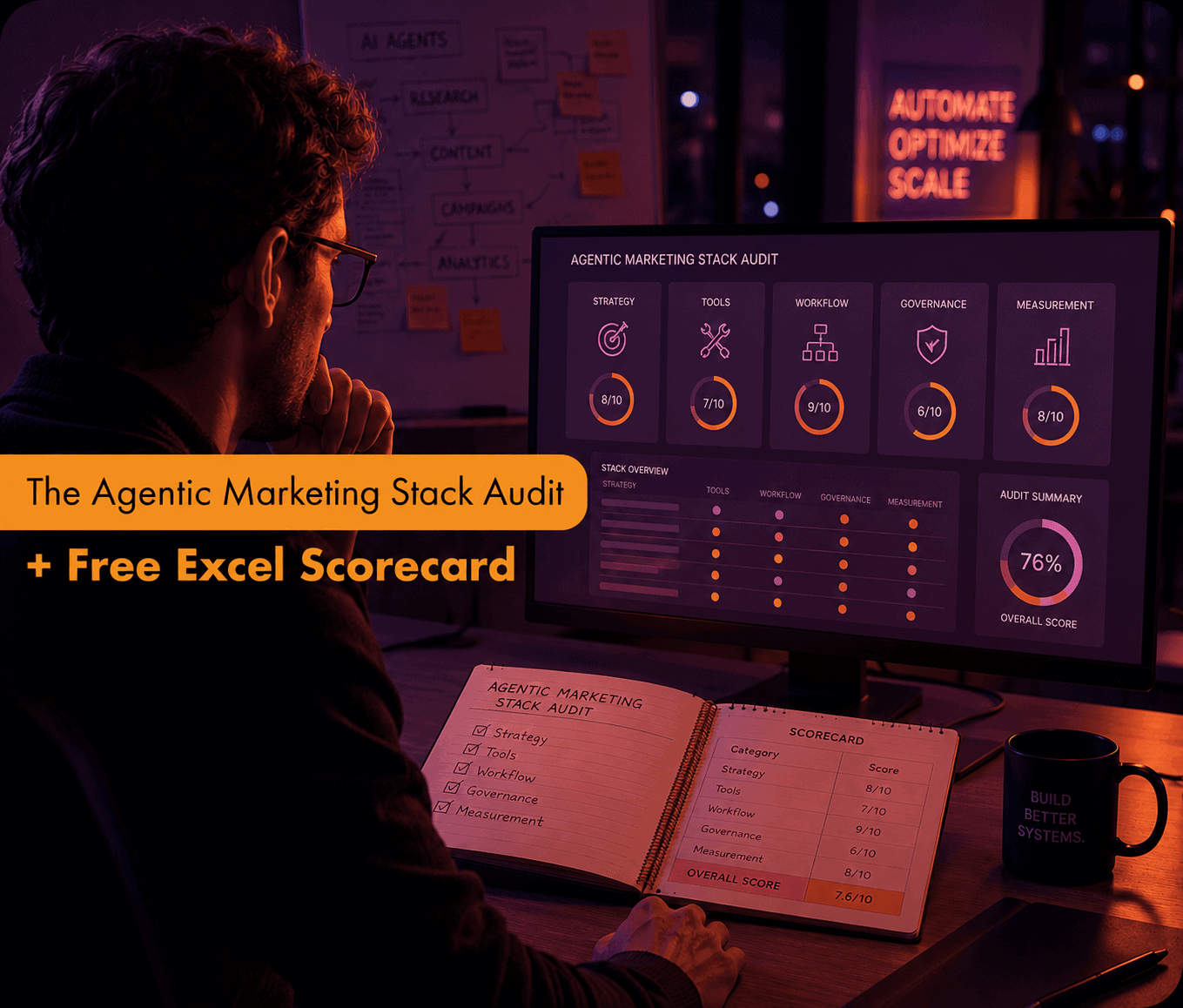
Grab the free Agentic Marketing Stack Scorecard below (it does the math, hands you your maturity band, and builds your fix-first list automatically) or the printable PDF. And if you would rather have it done with you, a real audit of your real stack, scored and prioritized by the team that wrote the checklist, that is exactly the kind of thing we geek out on.
A structured, scored review of every AI agent and autonomous workflow in your marketing operation, across inventory, integrations, evaluation, governance, content provenance, attribution, and ROI. It tells you whether your AI is safe to scale and whether it is actually profitable.
How often should I run an agentic stack audit?
Run a full audit at least quarterly. The agentic landscape moves fast enough that a six-month-old picture of your stack is already inaccurate. Teams running more than ten agents should re-inventory monthly.
What is a shadow agent?
Any AI workflow built without approval or oversight, usually in a personal ChatGPT or Claude account, self-hosted n8n, or a consumer automation tool. They are risky because they process brand and customer data outside your data agreements.
Do small businesses need an AI governance audit?
Yes, arguably more than enterprises. Big companies have compliance teams to catch problems. A lean team running agents without a CISO carries the same risks with fewer safety nets. The audit scales down cleanly.
What does NIST CAISI require for AI agents?
The NIST AI Agent Standards Initiative, launched under the CAISI framework in February 2026, sets expectations around agent interoperability, safety evaluation, and governance. US enterprise procurement teams increasingly reference it when vetting vendors.
Is putting customer data into ChatGPT a CCPA problem?
Often, yes. Consumer-grade tools are not covered by the enterprise data agreements that CCPA-style obligations assume. Use governed, business-tier tools with proper service-provider agreements for anything involving customer data.
How is an audit different from comparing AI tools?
A tool comparison answers which tools to buy or replace. This audit answers whether the stack you already run is safe, accurate, and profitable. You want both, but governance is the one that keeps you out of trouble. If you need help producing the work itself, that is where AI-generated content and automation comes in.
How long does the agentic stack audit take?
About three to four hours in one focused session. Each item is scoped so a marketing-operations lead can answer yes or no in under two minutes. The slow part is being honest, especially in the evaluation and ROI sections.
Get Your Stack Audited by the Team That Wrote the Checklist
You just saw all 50 points. We run this exact audit on real marketing stacks, score every item by blast radius, and hand you a prioritized fix-first list with the weight-3 compliance holes flagged first. If you would rather have it done with you than run it solo, that is the kind of thing we geek out on.




 Previous article


